Showing posts with label spelling. Show all posts

Thursday, May 24, 2012

quirks with the imperfect tense in French

You may recall my post on how to form the imperfect tense in French. I mentioned some freakiness with the double-i:

Nous étudiions. (We were studying.)

Nous skiions. (We were skiing.)

Another quirk to watch out for has to do with the letters c and g. I believe I've explained this in another post, but to reiterate:

When placed in front of the vowels a and o, the consonants c and g undergo a slight change if they're to be pronounced softly (i.e., the "s" sound for c, the "zh" sound for g): the c gains a cedilla, and the g takes on an extra e after it.

Examples: le français, nous mangeons

This is relevant when forming the imperfect tense. Take commencer, for example:

je commençais (note the cedilla)
tu commençais
elle commençait
nous commencions (note the lack of cedilla, because the c is followed by an i, not a or o)
vous commenciez
ils commençaient (cedilla again!)

Now watch what happens with manger:

je mangeais (note the additional e)
tu mangeais
il mangeait
nous mangions (no e!)
vous mangiez
elles mangeaient (e again!)

Keep these changes in mind as you master l'imparfait!


_

Wednesday, March 21, 2012

the varying dignity of letters

I respect the letter "i"
Which I find more dignified
Than "y" or "ee"

When I spell Korean words
On the page they're seen, not heard:
I write "kimchi"

Same is true when I write "u"
It's superior to "oo"
Ask Noh Moo Hyeon

Would you rather be a "Wu"?
Or instead a lowly "Woo"?
That can't be fun

Letters know their place and rank
Like the fishes in a tank
They dominate

Change a spelling, add some verve
Set your words upon the curve
From good to great

"Chattahoochee," lacking wit
Fails with dignity to sit
Upon the page

"Chatahuchi," by contrast--
There's a name that's meant to last
Through every age!

It's an orthographic game
But some spellings are too lame
To greet the eye

Know your letters! Treat them well!
Don't consign your words to hell
With glyphs awry!


I admit I like "y" when it's pronounced "ih" as in "dysfunction" or "nymph"-- or the aforementioned "glyph." "Y" acquires an aura of power and mystery(!) in such contexts.

But spelling a foreign word with unsavory letter choices leaves me cold: I don't like "kimchee," which looks infantile, but I do like "kimchi." While I'm used to seeing surnames romanized as "Lee" and "Woo," I prefer "Li" and "Wu." True: the "Lee" versus "Li" distinction is often useful in distinguishing Korean versus Chinese surnames, even though the respective surnames are derived from the same Chinese character. If, back in the beginning, the Koreans and Chinese had some sort of contest to decide who got to use which spelling, I think the Koreans got the short end of the stick. But I've also seen Koreans deliberately choose the lamer orthography, as in "Jee-young" instead of the far more dignified "Ji-yeong." That unsavory "ee" combination should be reserved for childish utterances: "Oh, gee!" or "Hee hee hee!" (which can't be rendered in English as "Hi! Hi! Hi!" for obvious reasons).

My orthographic sensibility kicks into overdrive whenever I see names like "Sarkozy" and "Grozny." Wouldn't Sarko's name be cooler as "Sarkozi?" The change from "y" to "i" would give it a sort of mafioso cachet. And "Grozny" is just plain sad, whereas "Grozni" is, at least, not totally prostrate.

For Koreans, the inconsistent romanization of Korean names has led to some intractable problems. What's the valence of "u," for example? In the official ROK romanization scheme, it's clearly an "ooh" sound, but so many Koreans use it to mean "uh" that it's hard to tell who means what (e.g., "Sun-hee," where "Sun" sounds like the English "sun," not "soon"). That's why a dude with the surname "Yoon" is probably trapped into writing it that way: were he to write "Yun," it'd be hard for a non-Korean to know whether the name should rhyme with "tune" or with "fun." (Officially speaking, "Yun" should be pronounced "yoon," and if the name rhymed with "fun," it would/should be romanized "Yeon.") "Yoon" looks too close to "cartoon" for my taste. The most infamous example of the Korean surname problem? "Moon."

Does anyone else share this aesthetic, or am I all alone on this one? If you do feel similarly about letters, do you deplore, as I do, the change of that cable channel's name from "Sci-Fi" to "SyFy"? I just can't take the new spelling seriously.


_

Wednesday, March 7, 2012

¡Ay, caramba!

From my Twitter feed, I was led to an article by Katy Meyers on the GradHacker blog about Stoicism in Grad School. Unfortunately, the article is horribly written, and I've highlighted, in red font, every instance of a mistake. Feel free to type a list of corrections in the comments. NB: one or two mistakes are minor in nature, but most are obvious, objective errors that should have been excised in a single wave of proofreading.

The piece has other problems as well (omitted colons, poor spelling and diction, etc.); feel free to fix those. I've reprinted the article below:

I used to be kind of a control freak, I think many grad students can attest to a similar personality trait. Sadly this tends to go along with the perfectionism that Julie talked about last week. Control is important, we need to be able to balance a number of lives as grad students, maintain multiple fellowships and jobs, work on our research as well as ace our classes, and make a good impression in the department as well as the broader discipline. Our success comes from the close control over every aspect of our professional and academic lives: mapping out every minute of our week into our Google calendars, tracking assignments through various iPhone apps, using Zotero to organize every bibliographic reference, and keeping up with the professionals through every social media site we can think of. This is good, it keeps us grounded.

So here’s the problem, you can’t control everything. This may come as a shock to some, I honestly thought in my first year of grad school that I could control every aspect of my life. I extended the necessity to control my academic world to my personal world. This personal control led to anxiety over family and friend relationships for not conforming exactly to the plans I had made up in my head, and massive fears about my department’s view of myself. I wasted precious energy and time worrying about things that I had no control over. I would lose sleep over things that were external to me. It got so bad that it led to physical damage when I starting unconsciously clenching my teeth at night, I now have a wonderful click sound in my jaw (TMJ for those who want the medical term).

That’s when my little brother suggested stoicism. Joel Mendez wrote “Contrary to common perception, being stoic doesn’t mean being emotionless. The real quality of Stoicism is far more masculine than not caring about anything – it’s about knowing when to care, when to be upset, and how to accept the inescapable with your head held higher than you thought possible.”

According to Mendez, if nature gives you a metaphorical slap in the face you can either get all worked up about wondering why this occurred to you or you can accept what occurred and realize there’s no use in crying over it, because you can’t control nature. There’s no point in freaking out because a freak snowstorm prevented you from getting to a presentation, its nature and you obviously couldn’t have done anything to prevent it from occurring. The second part of this is that you accept what things are occurring, you don’t let it affect your emotion, and you don’t retalitate or react. Using nature as an example is good because you can’t retaliate... I guess you could punch the snow, but it’s not going to change anything.

This is all well and good for interactions with nature, but how do we apply this to our lives in grad school? Stocism is about knowing and accepting your limitations. We can control our lives, our emotions, and our reactions to these metaphorical slaps in the face. We can’t control other people’s lives, emotions, or when they chose to slap us in the face. By giving up trying to control things in our life that we have no control over we end up gaining control over ourselves.

We have to accept that sometimes not everyone in your department will like us, we have to accept that some of our students are going to review us badly regardless of how well we teach, we have to accept that we can’t get funding for every thing we do, and we have to accept that our friends and family are not part of our sphere of control. This doesn’t mean giving in and going with the flow completely. Sometimes you do need to fight against funding agencies, and you can work harder to make some people in your department like you. But you need to know your limits, where you can affect change and where you cannot.

Stocism is about finding inner strength, and letting go of the necessity to control the views and actions of others. I leave you with this quote by Seneca the Younger: “Let Nature deal with matter, which is her own, as she pleases; let us be cheerful and brave in the face of everything, reflecting that it is nothing of our own that perishes.”

For a great summary of stocism check out Mendez’s article: The Modern Wimp’s Introduction to Stoicism.

What's most disturbing is that the article is written by someone who wants to talk about perfectionism as a stressor, but I see little evidence of perfectionism in her prose. The repeated misspelling of "stoicism" is a prime example of this sloppiness.


_

Wednesday, January 11, 2012

all hail ENGRISH!


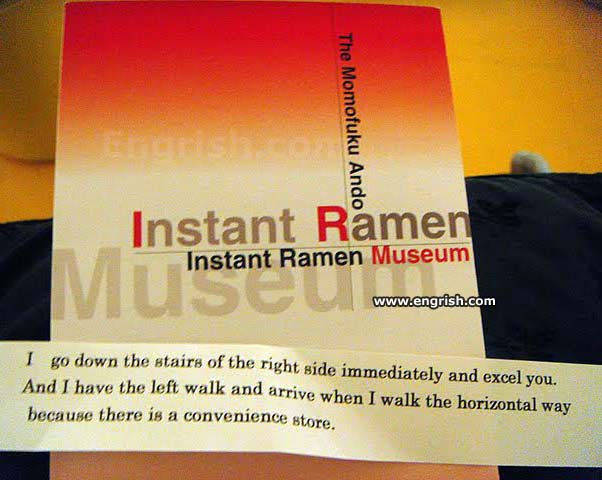
Engrish.com is a hilarious website that's been around for years. I first learned about it while I was living in Korea. The site features photos of mangled English, primarily from East Asian countries, much of which is uproariously nonsensical. Here are a few good ones, sorted by country.

China:

1. To help you rent a nice family.

2. Don't hurt me for your pretty!

3. Do not disorder rubbish here.


Japan:

1. I go down the stairs of the right side immediately and excel you.

2. Try to put on and out!

3. The wonderfully throbbing Christmas.


South Korea:

1. I do a lot of thing.

2. Crapmeat tortilla.

3. "Worm-up" clothing.


An exercise for the student of English: try to change the Engrish in the above-linked images into proper English!


_

Thursday, January 5, 2012

"regular" verbs that behave a bit strangely

In French, there are some verbs that are conjugated almost like good old regular verbs, but with some slight alterations. I want to talk about two major types of "almost-regular" verbs: (1) the -eCer verbs and the (2) -cer/-ger verbs.

1. -eCer verbs

This type of verb has an infinitive form that ends in "e," plus a single consonant, plus "er." Examples:

s'appeler (to be named/called)
jeter (to throw)
amener (to bring)
péter (to burst, fart)
se promener (to walk/go walking)

Watch how each of the above verbs behaves when each is conjugated in the present indicative (l'indicatif du présent):

s'appeler
je m'appelle
tu t'appelles
il s'appelle
nous nous appelons
vous vous appelez
ils s'appellent

jeter
je jette
tu jettes
elle jette
nous jetons
vous jetez
elles jettent

amener
j'amène
tu amènes
il amène
nous amenons
vous amenez
ils amènent

péter
je pète
tu pètes
elle pète
nous pétons
vous pétez
elles pètent

se promener
je me promène
tu te promènes
il se promène
nous nous promenons
vous vous promenez
ils se promènent

Notice anything in common about the ways in which the above verbs "twist" themselves away from the regular "-er" form? Perhaps the first thing to note is that the first, second, and third-person singular conjugations are all spelled differently from the infinitive: s'appeler gets a double "l"; jeter gets a double "t"; amener gets a grave accent (un accent grave); péter does, too; and so does se promener. There's no rule governing what -eCer verb gets which type of conjugation; as with all irregular verbs, these "almost-regular" verbs will simply need to be memorized.

Note, too, that the first- and second-person plural forms (nous et vous) are conjugated normally, i.e., in the manner of regular "-er" verbs. Finally, note that the third-person plural forms (ils, elles) go back to being slightly irregular.

Keep this irregularity in mind whenever you see any -eCer verbs.


2. -cer/-ger verbs

This type of "-er" verb ends in -cer or -ger. Examples:

lancer (to throw, launch)
annoncer (to announce)
commencer (to begin, start, commence)
manger (to eat)
plonger (to dive, plunge)
voyager (to travel)

Watch what happens when we conjugate the "-cer" verbs.

lancer
je lance
tu lances
il lance
nous lançons
vous lancez
ils lancent

annoncer
j'annonce
tu annonces
elle annonce
nous annonçons
vous annoncez
elles annoncent

commencer
je commence
tu commences
on commence
nous commençons
vous commencez
ils commencent


And now, the "-ger" verbs:

manger
je mange
tu manges
il mange
nous mangeons
vous mangez
ils mangent

plonger
je plonge
tu plonges
elle plonge
nous plongeons
vous plongez
elles plongent

voyager
je voyage
tu voyages
on voyage
nous voyageons
vous voyagez
ils voyagent


What rule do you see at work here? In truth, the rule is as much about pronunciation as it is about conjugation: in French, it's often the case that the pronunciation of the letters "c" and "g" will change in front of the vowels "a" and "o." This rule operates in nouns just as it does in verbs:

le français (not le francais)

So you have to understand that, if you want your "c" to sound like an "s" in front of "a" and "o," you need to add the cedilla (la cédille), that little diacritical mark that dangles under the "c." If you forget the cedilla and mistakenly write "le francais," a Frenchman will read that and mentally hear "le franké." Not pleasant.

For a "g" to be a soft "g" in front of "a" and "o," you need to add an "e." Hence: nous voyageons.

As with any language, French is full of irregularities. These can drive a beginning student crazy, but it's best to learn them well now; otherwise, you may form bad habits in your writing and speech later on. Strive for perfection as you learn the language so that you don't doom yourself to speaking it with a laughable accent. Bad habits, once formed, are very hard to unlearn.


_

Friday, October 21, 2011

spelling rant

STUDENTS! Here are three words that don't have an "a" in them:

definitely (not "definately")

independence (not "independance")

persistence (not "persistance")

Please don't make me pull my hair out. Make an effort to check your spelling. Don't do the sloppy thing and assume you're spelling correctly-- especially if you have a history of poor spelling. My own analogy for this sort of mental slovenliness is that of the litterer: a person who litters thinks to himself, "Meh... someone else'll come along and clean up my mess." And so he keeps right on littering, thereby demonstrating laziness and a lack of pride. By the same token, many people who fail to check their own spelling think to themselves, "Meh... I'll get a proofreader to look over my work. What are a few misspellings, after all?"

Don't be sloppy. Take pride in your work.

More language rants on the way.


_